
About SRS Spectral Matching
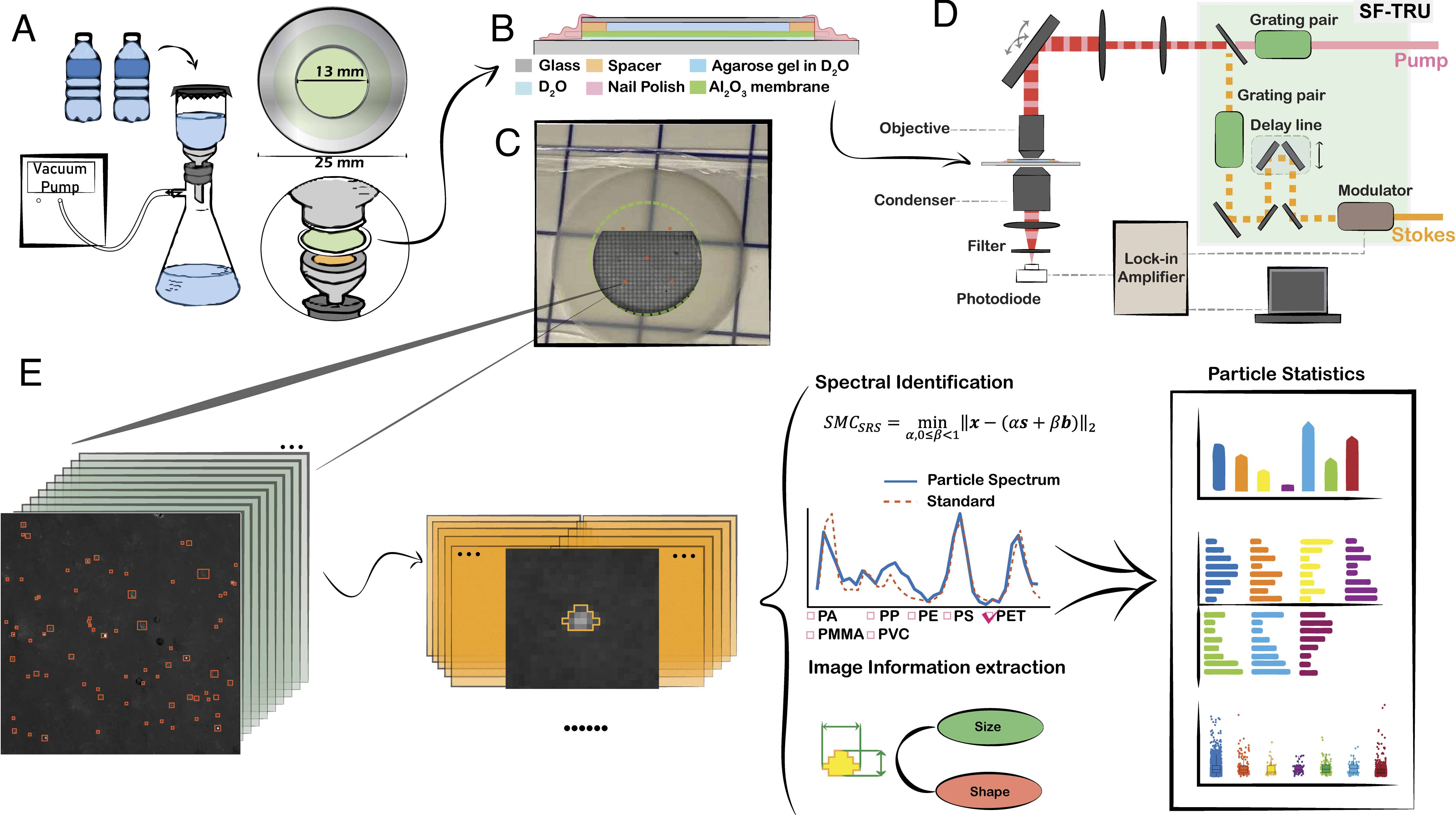
This method enables rapid chemical identification of individual nanoplastics using stimulated Raman scattering (SRS) microscopy. Researchers at PNAS developed the technique to overcome slow manual analysis of nanoplastic particles. The approach combines optical imaging with computational spectral matching.
The algorithm analyzes Raman spectra collected from single particles in real time. It compares spectral signatures against a reference library to identify plastic types automatically. This workflow reduces analysis time while maintaining chemical specificity.
Key Features
- Also provides open-source MATLAB code for spectral matching and plastic classification.
- Furthermore, the method detects nanoplastics at the single-particle level without destructive sample preparation.
- In addition, raw SRS imaging datasets from bottled water samples are publicly available on figshare.
- Additionally, the approach generates high-resolution chemical maps of heterogeneous particle mixtures.
Access and Data
The tool is freely available on GitHub as open-source MATLAB code. Raw imaging data and simulation code are deposited on figshare, enabling reproducibility and method validation. Users can apply the spectral matching algorithm to their own Raman datasets immediately.